
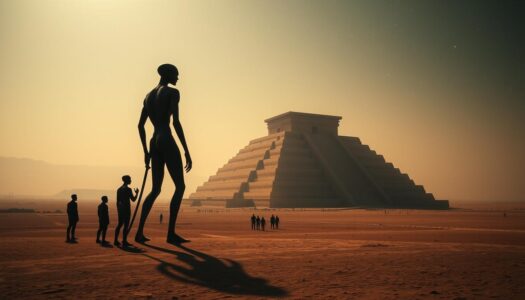
I’ve always been drawn to the ancient Mesopotamian deities known as the Anunnaki. I’m excited to share my insights with you. As a guide, I’ll help you understand these mythical beings better. This will give you a deeper look into their role in ancient cultures.
The Anunnaki are key figures in Sumerian, Akkadian, Babylonian, and Assyrian texts. These writings show their importance in the ancient world. I’ll explore their roles and functions, and how they remain relevant today. If you have questions or experiences, please reach out to Marysol.
Key Takeaways
- Understanding the Anunnaki’s role in Mesopotamian mythology
- Exploring the significance of ancient texts in revealing their importance
- Delving into the complexities of these mythical beings
- Gaining insight into their continued relevance in modern times
- Discovering the connections between ancient cultures and modern spirituality
The Origins of Anunnaki Mythology in Ancient Mesopotamia
Exploring the origins of Anunnaki mythology takes us to ancient Mesopotamia. This land was full of secrets and forgotten knowledge. The Sumerian mythology is rich and helps us understand these ancient deities.
The Sumerians thought the Anunnaki were born from An, the sky god, and Ki, the earth goddess. This idea is seen in the earliest Sumerian tablets.
Deciphering the Earliest Sumerian Tablets
The earliest Sumerian tablets, from the Post-Akkadian period, offer insights into Anunnaki mythology. By reading these ancient texts translated, we learn more about their role in Mesopotamian myths.
Key Translations That Changed Our Understanding
Some translations have greatly changed how we see the Anunnaki. For example, the Sumerian tablets show their part in creation myths and their link to the sky.
| Tablet Name | Content | Significance |
|---|---|---|
| Weld-Blundell Prism | Sumerian king list | Provides insight into Sumerian chronology |
| Epic of Gilgamesh | Story of Gilgamesh and his quest for immortality | Highlights the cultural significance of the Anunnaki |
| Enuma Elish | Babylonian creation myth | Describes the role of the Anunnaki in creation |
Anunnaki Mythology: What the Ancient Texts Actually Say
The ancient texts show us the complex world of Anunnaki mythology. The Sumerians saw the Anunnaki as godlike beings who greatly influenced human destiny.
The texts tell us that the Anunnaki were part of a detailed divine hierarchy. This hierarchy was key to the Sumerians’ view of the world and their place in it.
The Divine Hierarchy in Sumerian Pantheon
The Sumerian pantheon had a complex divine hierarchy. The Anunnaki held a major spot in this structure. They were seen as deciding human fates, with immense power.
The Council of Anunnaki and Their Powers
The Council of Anunnaki, made up of high-ranking gods and goddesses, could shape human destiny. They were believed to keep the universe balanced and their decisions final.
Learning about the Anunnaki’s role in the Sumerian pantheon is enlightening. By studying the ancient texts, we understand their importance in Mesopotamian mythology. This helps us appreciate their influence on ancient spiritual and cultural practices.
Recent Archaeological Discoveries About the Godlike Beings in Sumer
New tablets have sparked interest in the Anunnaki, ancient Sumerian godlike beings. These discoveries are changing how we see the Anunnaki and their role in ancient Mesopotamia.
Newly Unearthed Tablets from Iraq and Syria
Excavations in Iraq and Syria have found many tablets. These archaeological discoveries help us understand the Anunnaki’s role in ancient beliefs.
The tablets give us a look at the mythical beings the ancient Sumerians worshipped. They show the Anunnaki’s importance in ancient Mesopotamian life, affecting religion and society.
Studying these mythical beings helps us understand ancient Sumer’s culture and beliefs. It sheds light on the complex practices of this ancient civilization.
Conclusion: The Significance of Anunnaki Texts in Understanding Ancient Civilizations
I’ve delved into Anunnaki mythology, uncovering ancient Mesopotamia’s rich cultural heritage. The Anunnaki texts offer a unique glimpse into the beliefs and practices of these ancient societies. They provide insights that are just as relevant today.
Reflecting on these texts, I see how vital understanding Anunnaki mythology is. It helps us grasp the complexities of ancient cultures. If you’re curious about Anunnaki mythology, reach out to experts like Marysol. She can guide and support you.
Studying Anunnaki mythology enlightens us about the past and our present culture and spirituality. By exploring ancient civilizations’ mythology and culture, we appreciate the complexities of human experience more deeply.